People (adults and children) are happier and more likely to make positive change when those in authority do things
WITH them rather than TO them or
FOR them… or NOT at all.
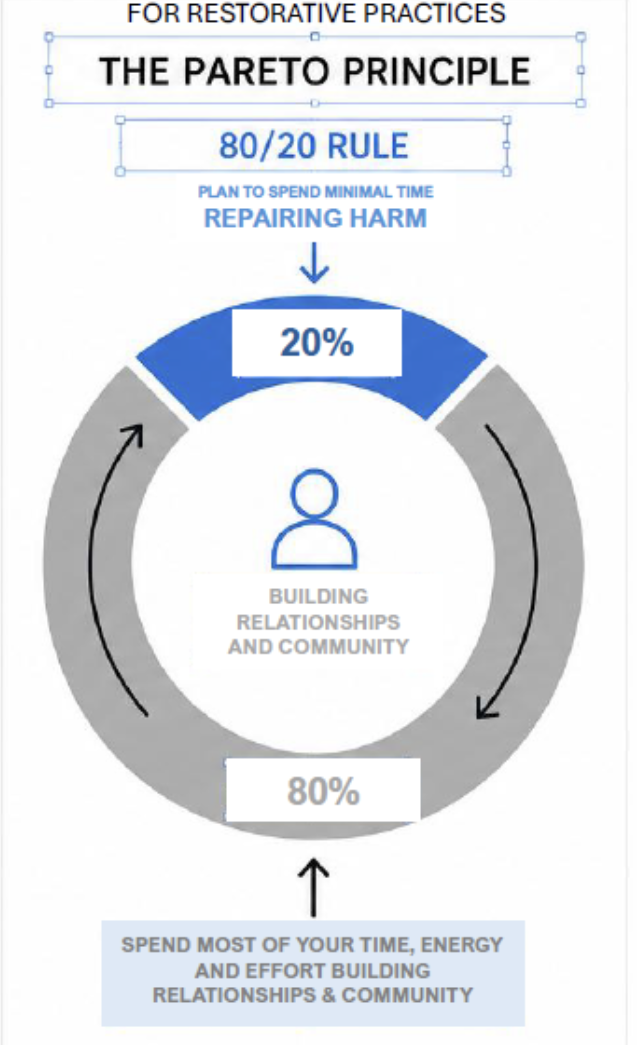
(See this diagram elsewhere on this site.)
- which is commonly known as the 80/20 Rule - declares that roughly 80% of outcomes or consequences result from 20% of causes.
In Restorative Practices, we say that 80% of our work should be in the area of building and maintaining relationships, community and belonging. That leaves only 20% of our time being necessary to address issues that arise because we haven't done a good job of building relationships and community.
(See this diagram elsewhere on this site.)
The Social Engagement Window helps us recognize our focus is to do everything as much as possible WITH those that we serve, where people are SUBJECTS to be HONORED, with an Inclusive TONE, Relaxed Alertness is the preferred BRAIN STATE, and there is a Focus on EMPOWERMENT, and a primary Activity of PROBLEM SOLVING.
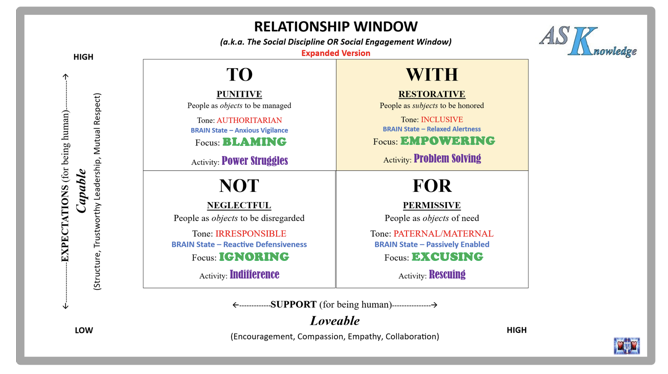
(See this diagram elsewhere on this site.)
Finally,
FAIR PROCESS IN LEADERSHIP
requires that those of us who lead in any way do so by first ENGAGING those for whom our decisions will have an effect, carefully EXPLAINING the rationale for why a decision must be made, and clarifying EXPECTATIONS for how we will move forward toward our particular outcomes. Then, it is just a matter of EXECUTING our plans, and EVALUATING the outcomes.
Ludo Van der Heyden, 2015
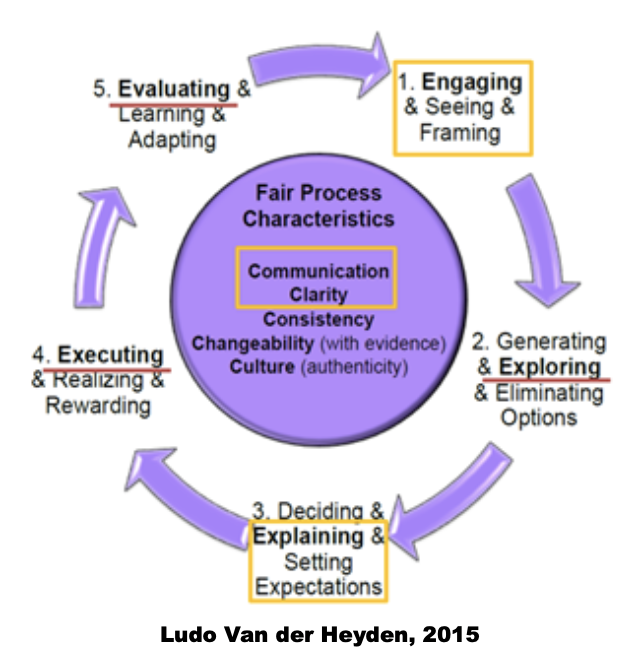
(See this diagram elsewhere on this site.)
This, then, is the essence of the restorative approach to practical and social engagement in a nutshell. All the rest are details. However, addressing these details with consistency and congruency is where restorative practices fidelity finds its fundamental and impenetrable foundation and most gratifying outcomes.
“Discipline is helping a child solve a problem. Punishment is making a child suffer for having a problem. To raise problem solvers, focus on solutions and not retribution.” L.R. Knost
Innovation, Nurturing Relationships, and Restorative Practices
Janet Fox Petersen, EdD
School Psychologist, Wichita, KS Public Schools
Much of what we know about the powerful influence of relationships on learning and cognition emanates from the work of the child psychologist, Lev Vygotsky. Vygotsky (1962) asserted that language, conversation, and relationships are central to learning and brain development. Human beings are relational and research indicates that respectful, inclusive, and connected relationshipsare integral to the overall safety and well-being of individuals, families, schools, and communities (Whitlock, 2006). Given the plethora of research on the importance of nurturing relationships in schools, innovative and evidence-based approaches that work are essential.
Building Caring Relationships Through Restorative Practices
One helpful and innovative paradigm available to schools for building caring and connected relationships is that of restorative practices (RP). RP brings a fresh approach to fostering strong school communities with high expectations and caring relationships. Through a robust continuum of informal to formal restorative approaches, conversations, and conferences, RP focuses on teaching respectful communication skills, listening and speaking; community building and belongingness; peaceably resolving conflict; and repairing harm to relationships when harm has occurred. At the core of restorative practices is a relational approach to problem solving. When conflicts arise among relationships due to misunderstandings, hurt feelings, competing needs and interests, rules being broken, differences of opinions, and behaviors that have brought harm to others, opportunities are provided for all those involved to share honestly about what happened, to listen empathetically to one another’s perspective, to accept ownership for one’s part and repair harm that may have occurred, and to restore positive relationships within the school community. Further, school staff demonstrate care by establishing firm and clear boundaries and expectations for student behaviors and communicating that while we mightnot like the behaviors we observe, we still care about the welfare and wellbeing of the individualas a human being. In other words, a restorative approach to caring relationships when problems arise is that we “separate the deed from the doer.”
Primary Philosophy of RP
According to Costello, J. Wachtel, and T. Wachtel (2010), the primary philosophy of RP asserts that people do better, are happier, and more successful when those in authority do things WITHthem (restorative, authoritative), rather than TO them (punitive, authoritarian), FOR them (permissive, overprotective), or NOT at all (neglectful, indifferent). For example, school staff who seek to do things restoratively WITH students (a) value the voices and experiences of students and their families, embracing differences and diverse cultural backgrounds; (b) model behaviors they want to see; (c) are firm, fair, and warm; (d) are assertive rather than aggressive; (e) focus on repair, healing, and teaching needed skills; and (f) achieve compliance through relationships, communication, and community rather than through coercion and force. School staff engaged in restorative and relational approaches are exponentially more effective in motivating students to achieve than those who seem disconnected from students’ real-world problems at best, or are adversarial at worst. Implemented well, RP shifts the focus of discipline from retribution, which frequently leads the punished to become angry with the punisher rather than to reflect on and accept responsibility for their own behaviors, to increased accountability for those participating in wrongdoing and a renewed sense of community for all those involved in the restorative process.
Robust Continuum of Restorative Approaches to Caring Relationships
RP is a multi-tier system of supports (MTSS) in which restorative approaches are provided for all students at the primary level, Tier I, for some students at the secondary prevention level, Tier II, and more intense interventions for a few students at the tertiary level, Tier III (see Table). A helpful tool in RP to encourage accountability, caring relationships, and school connectedness is the circle. In the circle, participation is voluntary, a talking piece may be used so everyone has an opportunity to speak, and the focus is on building inclusive relationships and repairing harm when harm has occurred in classrooms and the in school community. Restorative questions are another integral part of the restorative approach. Restorative questions provide opportunities for teaching perspective taking, empathy, and conflict resolution skills; assuming responsibility for wrongdoing; and repairing harm (Abramson, 2014). Additionally, restorative questions may serve as a vehicle to empower those affected or harmed by wrongdoing. The process is facilitated to be fair to all parties involved. Here is an example of restorative questions that may be used in a restorative conference:
1. What happened? (Are you willing to consider there may be multiple perspectives about what happened?)
2. Who was affected and harmed by what happened and in what way?
3. What do you think must happen to repair the harm and prevent it from happening again?
The restorative questions provide opportunities for students to critically think for themselves and reflect on their actions and how they have affected other people. Depending on the circumstances, restorative questions are appropriate for use in a variety of situations, ranging from informal conversations with individual students, small groups, and in classrooms to highly formal small group conferences with a trained facilitator. The following is a table of possible RP strategies school staff may use to encourage high expectations and caring relationships.
RP and MTSS
| Tier | Level | Restorative Practice |
| Tier I | Universal: All Students | Community building and peacemaking circles, informal restorative conversations, caring relationships before rules and standards, inclusive school climate, common values, trauma informed, engaging parents |
| Tier II | Secondary: Some Students | Impromptu restorative conversations, restorative questions, conflict mediation, restorative conferences, peace keeping agreements, trauma informed,apologies, restorative questions, engaging parents |
| Tier III | Tertiary: Some Students | Alternatives to suspensions and expulsions, formal restorative conferences with a trained facilitator, repairing harm, formal apologies, reintegration after suspension or expulsion without shaming or blaming, restorative questions, collaborative consequences, engaging parents |
Table
Paradigm Shift Needed from Punishment to Healing and Repair
For many, embracing the restorative approach and philosophy, a significant paradigm shift is needed. The shift involves moving from a mindset that in order to have a safe and high performing school, adults must exert power over students and punish them for wrongdoing (doing things TO them, which is more likely to increase resentment than affect lasting change) to a mindset of working WITH students, seeking collaboratively to select consequences that best serve the outcomes we want. The shift involves the understanding that human beings are relational and thrive in contexts of social engagement and caring relationships over environments focused on punishment and retribution.
References
Abramson, L. (2014). Being emotional, being human: Creating healthy communities and institutions by honoring our biology. In V. Kelly & M. Thorsborne (Eds.). The psychology of emotion in restorative practice: How affect script psychology explains how and why restorative practices works (pp. 84-104).
Costello, B., Wachtel, J., & Wachtel, T. (2010). Restorative circles in schools: Building community and enhancing learning. Bethlehem, PA: International Institute for Restorative Practices.
Vygotsky, L.S. (1962) Thought and language. Cambridge, MA: MIT Press.
Whitlock, J.L. (2006). Youth perceptions of life in school: Contextual correlates of school connectedness in adolescence. Applied Developmental Science, 10(1), 13-29.