People (adults and children) are happier and more likely to make positive change when those in authority do things
WITH them rather than TO them or
FOR them… or NOT at all.
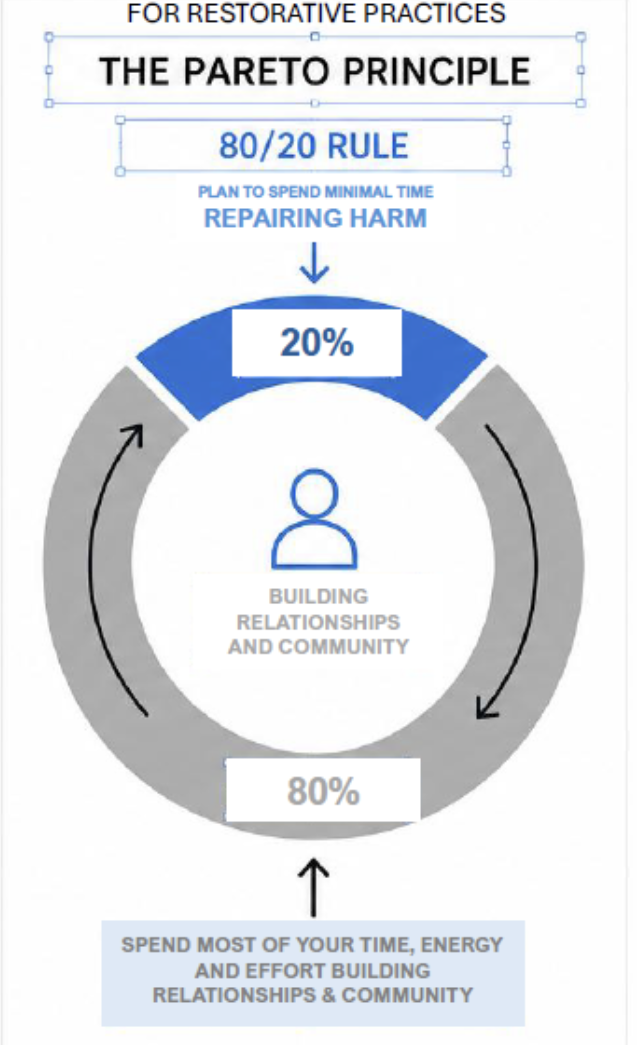
(See this diagram elsewhere on this site.)
- which is commonly known as the 80/20 Rule - declares that roughly 80% of outcomes or consequences result from 20% of causes.
In Restorative Practices, we say that 80% of our work should be in the area of building and maintaining relationships, community and belonging. That leaves only 20% of our time being necessary to address issues that arise because we haven't done a good job of building relationships and community.
(See this diagram elsewhere on this site.)
The Social Engagement Window helps us recognize our focus is to do everything as much as possible WITH those that we serve, where people are SUBJECTS to be HONORED, with an Inclusive TONE, Relaxed Alertness is the preferred BRAIN STATE, and there is a Focus on EMPOWERMENT, and a primary Activity of PROBLEM SOLVING.
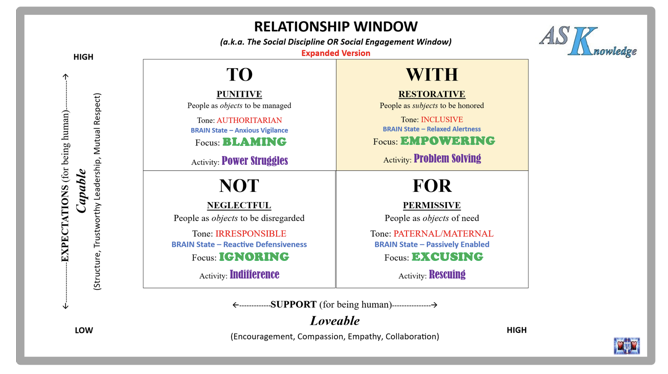
(See this diagram elsewhere on this site.)
Finally,
FAIR PROCESS IN LEADERSHIP
requires that those of us who lead in any way do so by first ENGAGING those for whom our decisions will have an effect, carefully EXPLAINING the rationale for why a decision must be made, and clarifying EXPECTATIONS for how we will move forward toward our particular outcomes. Then, it is just a matter of EXECUTING our plans, and EVALUATING the outcomes.
Ludo Van der Heyden, 2015
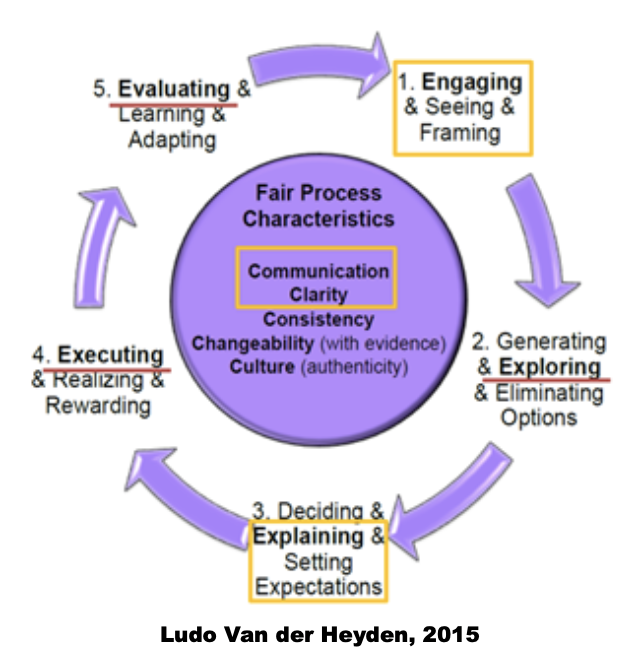
(See this diagram elsewhere on this site.)
This, then, is the essence of the restorative approach to practical and social engagement in a nutshell. All the rest are details. However, addressing these details with consistency and congruency is where restorative practices fidelity finds its fundamental and impenetrable foundation and most gratifying outcomes.
Retired and current teachers, school administrators or counselors, social workers or school psychologists, coaches and paraprofessionals, or school nurses ... if you are one of these or need restorative insights from one or more of these, we likely have access to what you need within our team or from within our network.
We know the power of well-built relationships in a school setting, and how to apply tools and strategies to shape an inviting school climate where interpersonal connections are prioritized with all constituents of school families. From the youngest of students to the oldest of parents and grandparents, and between schools and school districts and the communities they serve and which serve them, there are opportunities to strengthen connections and achieve better and better outcomes. Restorative practices provide LEVERAGE for doing so easier and better.
You just need to be willing to make optimizing relationships your top priority!
We provide professional development in a variety of ways depending on your needs, circumstances, and clientele This includes in-person sessions, video conferencing, publications, coaching, and consultations.
Many of the folks connected with CRC have worked for ... or in some cases started non-profit and other community organizations. Otherwise, we have partnered with such groups and can see the visions and missions, and opportunities and challenges of community groups from inside and outside of them – historically or currently, or both.
Restorative practices attitudes, skills and knowledge are often if not invariably universally applicable and can enhance the missions of almost any group because of the focus on connectedness and using improved communication, cooperation, and collaboration for improved outcomes.
Let us know who you serve and where you struggle to be of service and let us help you enhance your experience by looking at it through a restorative lens.
Wherever there are people, there is politics – and congregations are no exception to this. Whether you are part of a church, synagogue, mosque, temple, hall, or any other place of worship where people gather on a regular basis, it is true that you are engaged in a process by which your group makes collective decisions, resolves conflicts, and distributes power and resources within your gathering.
Clearly, a focus on relationship and community is primary in the world of congregations, but the process for doing so rarely emerges from a lock-step adherence to the same principles. Congregants may ascribe to the same vision and mission but may not agree on the steps required to get there. Here is where something like a dialog circle is powerful, and where consensus and norming are processes that may trump Robert’s Rules of Order and even a democratic process for religious groups to find a cooperative way forward.
At least occasionally, conflicts will arise; and whether between specific individuals, or factions, or leadership and laity, there is likely a restorative approach that can help you move through the disconnect successfully.
Putting it simply, businesses of all kinds exist to provide goods and/or services to a clientele, and to make a profit for the sake of those who own the enterprise – whether it be a mom-and-pop enterprise or a huge corporation. Both are essential or the business cannot survive.
What sometimes gets lost in this dynamic duo of intentions are:
In restorative practices, the focus is on doing things WITH those who are involved in a collective as opposed to doing things TO them, or FOR them, or being neglectful. This is where “Fair Process in Leadership” is essential, and at the very least you ENGAGE constituents in the process of decision-making for the company, EXPLAIN your decisions carefully, and clarify EXPECTATIONS of those who are involved in the business ... excluding no one.
The classic way of doing business is often more like a steamroller than a dance ... and restorative practices can begin to reverse that without losing any benefits of the two fundamental intentions businesses have. New Age business attitudes can be just as effective as classic ones (if not more so) and can do so with generations old strategies that are informative of the restorative methodology.
Let us explore this with you.