(316) 350-7585 | info@centerforrestorativecommunities.org

Restorative Practices:
BASIC PHILOSOPHPY


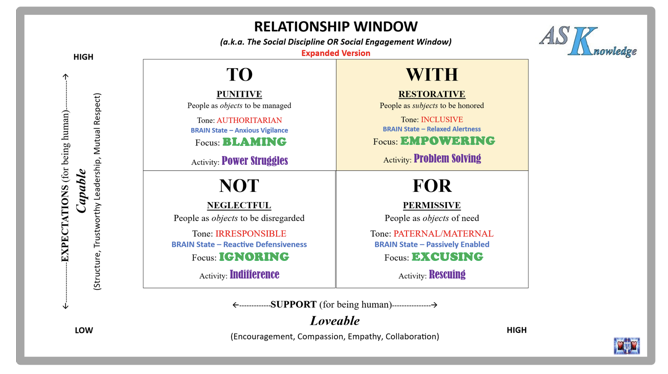
People (adults and children) are happier and more likely to make positive change when those in authority do things
WITH them rather than TO them or
FOR them… or NOT at all.
(See this diagram elsewhere on this site.)

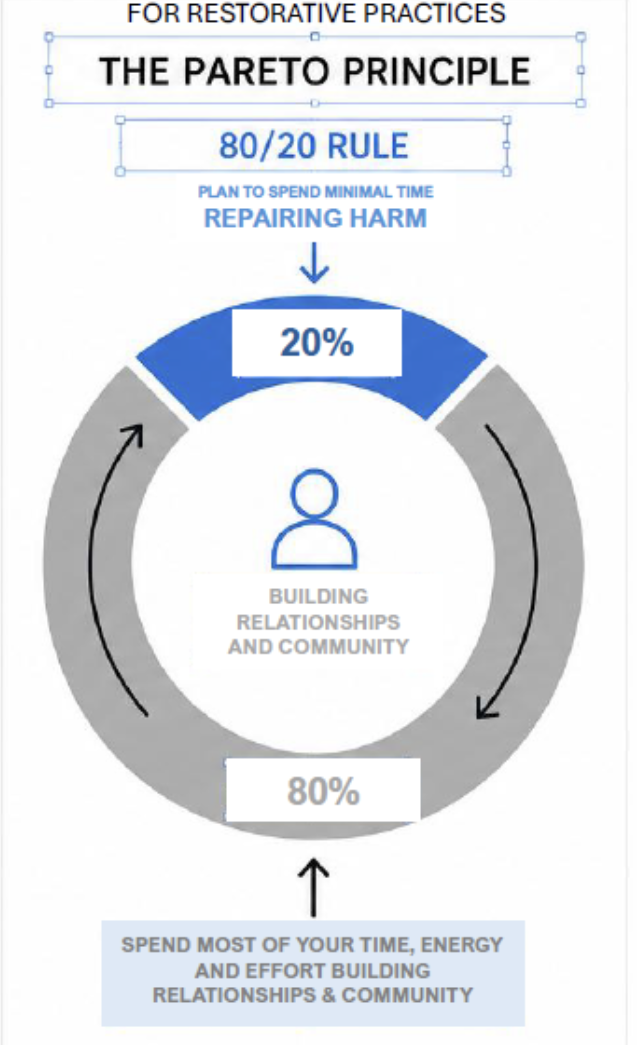
The Pareto Principle

- which is commonly known as the 80/20 Rule - declares that roughly 80% of outcomes or consequences result from 20% of causes.

In Restorative Practices, we say that 80% of our work should be in the area of building and maintaining relationships, community and belonging. That leaves only 20% of our time being necessary to address issues that arise because we haven't done a good job of building relationships and community.
(See this diagram elsewhere on this site.)

The Social Engagement Window helps us recognize our focus is to do everything as much as possible WITH those that we serve, where people are SUBJECTS to be HONORED, with an Inclusive TONE, Relaxed Alertness is the preferred BRAIN STATE, and there is a Focus on EMPOWERMENT, and a primary Activity of PROBLEM SOLVING.
(See this diagram elsewhere on this site.)

Finally,
FAIR PROCESS IN LEADERSHIP
requires that those of us who lead in any way do so by first ENGAGING those for whom our decisions will have an effect, carefully EXPLAINING the rationale for why a decision must be made, and clarifying EXPECTATIONS for how we will move forward toward our particular outcomes. Then, it is just a matter of EXECUTING our plans, and EVALUATING the outcomes.

Ludo Van der Heyden, 2015
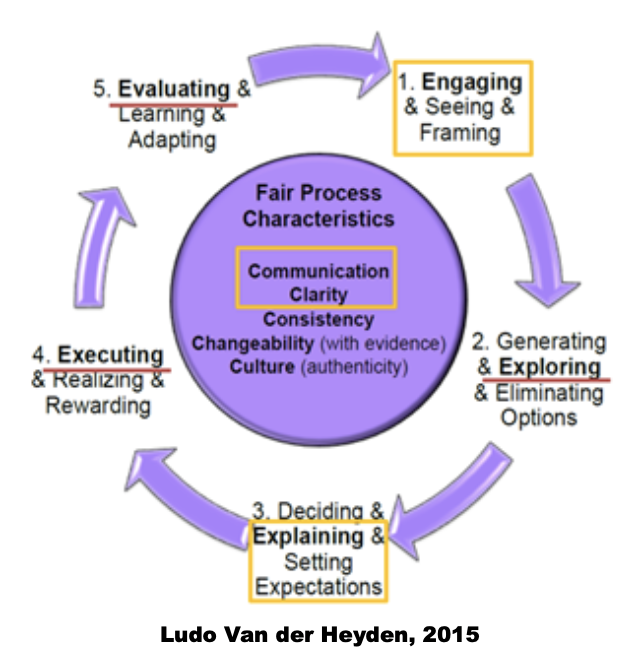
(See this diagram elsewhere on this site.)

This, then, is the essence of the restorative approach to practical and social engagement in a nutshell. All the rest are details. However, addressing these details with consistency and congruency is where restorative practices fidelity finds its fundamental and impenetrable foundation and most gratifying outcomes.

MISSION

Bring a mindful and restorative approach to building community – teaching people how to reduce conflict, repair harm to relationships, and achieve greater peace in their world.

VISION

People working collaboratively WITH each other to build restorative, empowered, and connected communities for all.

OBJECTIVES

I. 

Design research and best practices based transformative training models to work with people of all ages – from children and teenagers to adults in all phases of life
for:
individuals
families
small groups
large groups (up to 40 people)

II. 

Provide Training in, restorative practices, restorative relationships, and harm repair. Also...
Talking Circles
Compassionate Communication 
(a.k.a. Nonviolent Communication)
The Language of Intervention
Dialogue with Reflective Listening
Love Languages
Positive Self- Affirmation & Positive Action
The Four Agreements
Mindfulness
Holistic Social Engagement*: No One Is An Island
*(Understanding communication and dealings between individuals, groups and organizations in society as intimately interconnected and most meaningful and productive in reference to the whole.)
MORE!

III. 

Provide skills to improve the overall climate in organizations – including businesses, schools, congregations, and other community agencies
• Promote collaboration, cooperation and shared leadership
• Promote non-violent communication and building mutually empowering relationships
• Consult with schools to improve overall positive school climate and to reduce bullying and other forms of aggression
• Help improve relationships within and between churches, mosques, synagogues, temples and other congregations
• Help improve public discourse between opposing political factions

IV. 

Provide training in conflict resolution and mediation to equip people in conflict to work together to heal rifts and repair harm
• Address conflict within families to help improve family relationships
• Address conflict among children, teens and young adults in schools and social settings
• Address conflict in businesses, non-profit organizations, government and other agencies

V.

Teach skills in understanding and regulating emotion

VI.

Teach stress and anger management strategies
• Recognizing and expanding “Circles of Influence”
• Living “The Four Agreements”
• Peace, Courage & Wisdom
• More

VII.

Teach about the effects of trauma on brain development and trauma informed responses for schools and other agencies working with children and adults.

VIII.

Provide life coaching
• How to discover and develop life purposes
• How to manage fear and establish focus
• How to persevere and reach goals incrementally
• How to live in the moment while establishing goals for the future
• How to achieve more with less through leverage

IX.

Facilitate empowering understandings to and about the LGBTIA+ population and other marginalized groups
X. Develop a “Board of Advisors” and/or “Board of Directors”
XI. Publish books and other resources
XII. Develop trainer cadre to extend the reach of the founders
XIII. Network and form partnerships or coalitions with individuals and groups doing similar or complementary work
XIV. Develop an approach to influence public opinion
XV. Develop an approach to influence political decision-making at all levels

connect

Name

Facebook

Contact
(316) 350-7585
info@centerforrestorativecommunities
1736 Womer Drive
Wichita, Kansas 67203-1538

Rob Simon
rob@centerforrestorativecommunities.org

Jan Fox-Petersen
jan@centerforrestorativecommunities.org
Privacy PolicyCopyright 2025 CFRC - All rights reserved.