People (adults and children) are happier and more likely to make positive change when those in authority do things
WITH them rather than TO them or
FOR them… or NOT at all.
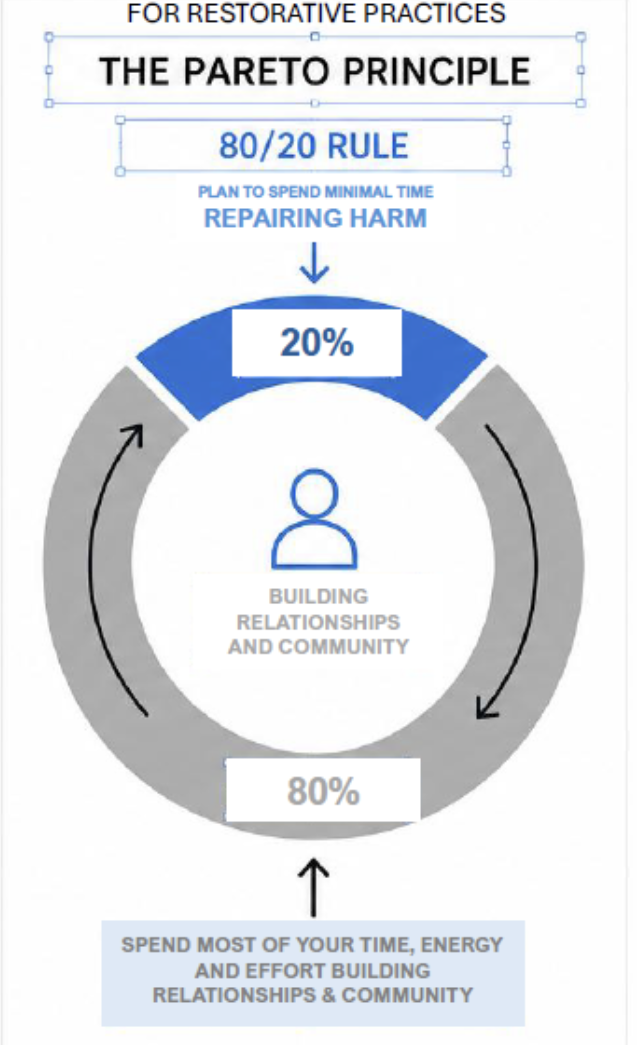
(See this diagram elsewhere on this site.)
- which is commonly known as the 80/20 Rule - declares that roughly 80% of outcomes or consequences result from 20% of causes.
In Restorative Practices, we say that 80% of our work should be in the area of building and maintaining relationships, community and belonging. That leaves only 20% of our time being necessary to address issues that arise because we haven't done a good job of building relationships and community.
(See this diagram elsewhere on this site.)
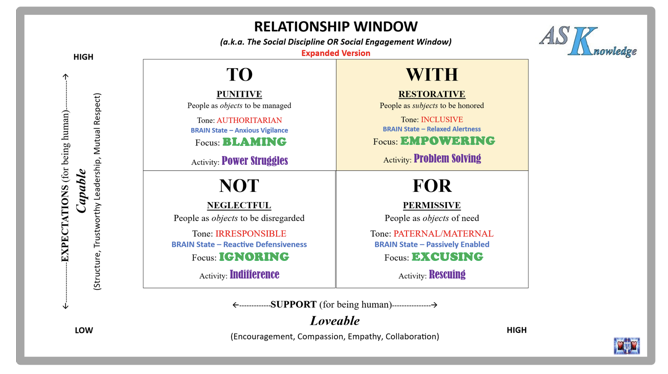
The Social Engagement Window helps us recognize our focus is to do everything as much as possible WITH those that we serve, where people are SUBJECTS to be HONORED, with an Inclusive TONE, Relaxed Alertness is the preferred BRAIN STATE, and there is a Focus on EMPOWERMENT, and a primary Activity of PROBLEM SOLVING.
(See this diagram elsewhere on this site.)
Finally,
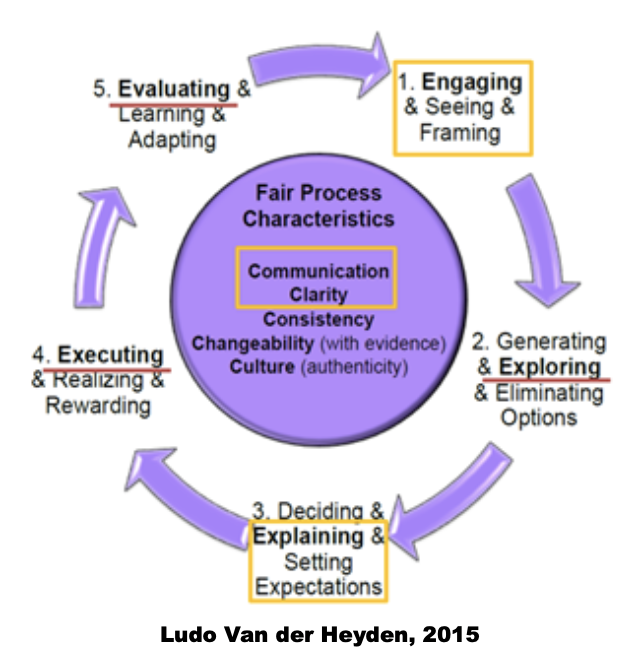
FAIR PROCESS IN LEADERSHIP
requires that those of us who lead in any way do so by first ENGAGING those for whom our decisions will have an effect, carefully EXPLAINING the rationale for why a decision must be made, and clarifying EXPECTATIONS for how we will move forward toward our particular outcomes. Then, it is just a matter of EXECUTING our plans, and EVALUATING the outcomes.
Ludo Van der Heyden, 2015
(See this diagram elsewhere on this site.)
This, then, is the essence of the restorative approach to practical and social engagement in a nutshell. All the rest are details. However, addressing these details with consistency and congruency is where restorative practices fidelity finds its fundamental and impenetrable foundation and most gratifying outcomes.
For the 2019-2020 school year, even more hard work is underway in the Wichita Public Schools to create the best possible school environments for students in attendance. There is now a concerted effort to expand an approach called “Restorative Practices” to all Wichita Schools, and so it’s also a perfect time to invite parents to help support the more positive school climate that results, and work together with educational professionals to improve outcomes for our students.Our ultimate goals are to...
• increase academic achievement and social and emotional learning;
• help students develop a belief in themselves to achieve at a higher level;
• improve the school climate, and student connection to and participation in school; and
• reduce suspensions and expulsions in favor of other disciplinary policies.
In a variety of ways, many staff members and students are already building better relationships and more of a sense of community in schools, but they need more help. Promoting peaceable ways to deal with conflict and stress is no easy task. More and more and more, our students are coming into schools thinking violence and verbal aggression is the only way – partly because they are exposed to it so much.
We know that some students LIVE with it every day, and ALL of us are drowning in a culture of violence thanks to the media – which seems to be focused on keeping us distracted and making us feel fearful. Providing tools for students to respond differently in their interactions with each other is critical. That is what USD 259 is diligently working to do.
In particular, we are promoting nonviolent ways of resolving conflicts by working on solutions WITH each other as opposed to doing things TO people, FOR people, or NOT at all. To illustrate this, we often use what we call the Social Discipline Window. Here is a version of it:
What we are working toward is having more and more of our interactions occur in the orange section of the window at the upper right corner. Here, we are fitting ourselves together like puzzle pieces, working WITH each other for a better world at all levels – what we call being RESTORATIVE. The other choices are all much less effective.
We DON’T want to do things TO people (the upper left corner) – even if we believe we have their best interests at heart. One reason is because people are much more likely to support what they help create. Also, when issues are difficult, doing things TO people ... being PUNITIVE(or punishing) in our tone or approach can make them feel like someone is throwing bricks at them ... and they want to just throw bricks back. This just adds more violence – even if it is verbal rather than physical.
Furthermore, we don’t want to do things FOR people (lower right corner) – even if it is easy, or seems expedient or helpful. Struggling to achieve goals is important for people in the same way that a chick struggling out of an eggshell at hatching time is important. Without that struggle, we don’t develop the skills and strengths we need to be productive members of society and achieve our chosen successes. We are being PERMISSIVE here, as if we are feathering the nests of people with cotton balls, and just making them dependent on others rather than their own gifts and talents.
Finally, as in the lower left window pane, we don’t want to be in the position or habit of NOTdoing anything to move society forward in a positive way. We don’t want to be NEGLECTFUL, as if ignoring or avoiding our problems will make them go away. People feel erased by neglect – as if they don’t matter, as if there is no hope, as if they don’t exist. Already, there is too much of that feeling in the world, and it is because of our unwillingness or inability to apply restorative ideas, or our lack of knowledge about them.
We know from our experience and from extensive available research that a positive school, work, or home climate – where people feel included, respected, valued, and connected – is KEY to improving performance, and social and emotional learning. This goal is vital to all of us, and Wichita schools are working on it in a variety of ways every day. We cannot, however truly be successful without help from parents and the community. Students need to get a consistent empowering message from every corner of their environment because the future is in their hands.
We appreciate what anyone can do to support a school in which all members feel emotionally and physically safe, but we all need to do more. In a world that seems to get crazier and crazier because of our apparent dedication to violence of all kinds, we doubt that we can afford NOT to go all in to save our children, and help them be prepared to turn the tide towards a more peaceful world ... before it’s too late.
Please do let school leaders know if you have any input and suggestions about the work they are doing with Restorative Practices, and especially ask questions until you fully understand what this paradigm means. Restorative Practices is not a project that is here today and gone tomorrow, but a new way to approach a universally classic and effective way to best interact with each other in relationship – especially when things go wrong and harm is done.
With Restorative Practices, we are asking what works, what doesn’t work, and what kinds of strategies are most helpful. You can help us find the answers.