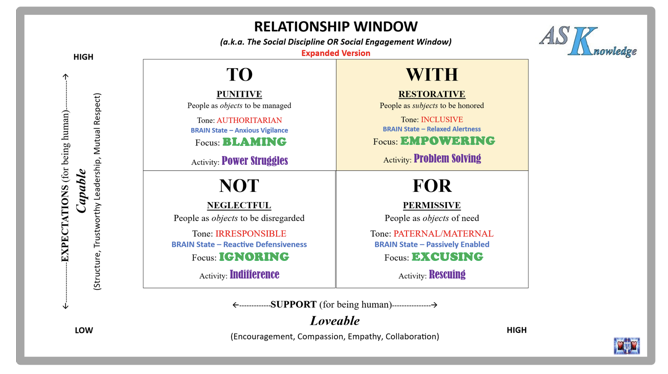
People (adults and children) are happier and more likely to make positive change when those in authority do things
WITH them rather than TO them or
FOR them… or NOT at all.

(See this diagram elsewhere on this site.)
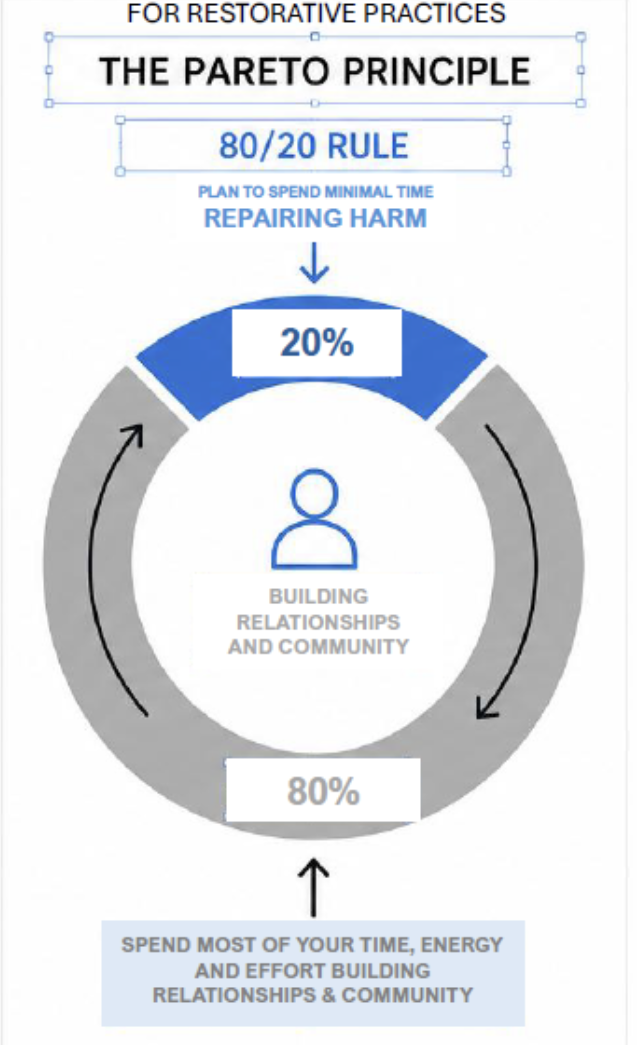
- which is commonly known as the 80/20 Rule - declares that roughly 80% of outcomes or consequences result from 20% of causes.
In Restorative Practices, we say that 80% of our work should be in the area of building and maintaining relationships, community and belonging. That leaves only 20% of our time being necessary to address issues that arise because we haven't done a good job of building relationships and community.
(See this diagram elsewhere on this site.)
The Social Engagement Window helps us recognize our focus is to do everything as much as possible WITH those that we serve, where people are SUBJECTS to be HONORED, with an Inclusive TONE, Relaxed Alertness is the preferred BRAIN STATE, and there is a Focus on EMPOWERMENT, and a primary Activity of PROBLEM SOLVING.
(See this diagram elsewhere on this site.)
Finally,
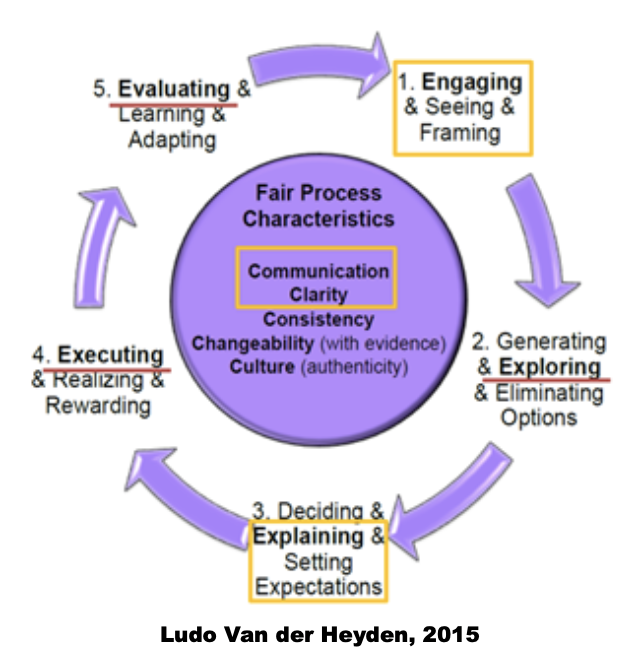
FAIR PROCESS IN LEADERSHIP
requires that those of us who lead in any way do so by first ENGAGING those for whom our decisions will have an effect, carefully EXPLAINING the rationale for why a decision must be made, and clarifying EXPECTATIONS for how we will move forward toward our particular outcomes. Then, it is just a matter of EXECUTING our plans, and EVALUATING the outcomes.
Ludo Van der Heyden, 2015
(See this diagram elsewhere on this site.)
This, then, is the essence of the restorative approach to practical and social engagement in a nutshell. All the rest are details. However, addressing these details with consistency and congruency is where restorative practices fidelity finds its fundamental and impenetrable foundation and most gratifying outcomes.
June 29, 2026
It has been said that if you dig deep enough beneath any negative emotion, you will find fear. Start with anger, hatred, jealousy, embarrassment, envy, bigotry, and more… and then ask the person who feels this emotion what he or she is really afraid of and there will probably be an answer… IF the person is honest. Fear is OFTEN at the root of other deep feelings that lead to violent and other counter-productive behaviors
If you check current news reports, you can find examples galore of how this rootedness plays out. And history produces arguably an infinite number of others.
Once upon a time in Cincinnati, for example, a black man lost his life at the hands of white police officers. There was talk of racism and police brutality… and rightly so as the facts of the case were considered. But I wonder whether or not anyone talked about how both cocaine and PCP – drugs that the dead man had in his system – are capable of turning anyone into a raging, superhuman maniac.
While not excusing or minimizing their behavior and the resulting consequences, I have no doubt that the six cops who subdued this 300 pound man could have been afraid under the circumstances. I also have no doubt that fear was at the root of the victim’s behavior relative to his drug use and much more. The fact that we may never know what he was afraid of doesn’t preclude the fact that fear was most likely there.
Of course, the current morass in the Middle East is a premier example of the primacy of fear. Go to any place in this hotbed of conflict where war is currently a daily experience, and fear will be there – whether it is among initiating forces or victims of the same. Palestinians are afraid of Israelis and Israelis are afraid of Palestinians. People outside of the Middle East are afraid of what’s happening inside, and those inside are afraid of what’s happening outside.
Then there are countless examples from history. The people of Illinois were afraid of the Mormons when they ran them out of Nauvoo. The Nazis were afraid of Jews, gypsies, and other people they persecuted and destroyed. Early American settlers were afraid of Native Americans. Early African settlers were afraid of native Africans. Natives on practically every continent were … and still are… afraid of each other. There was fear in Kosovo, and Afghanistan, ancient Rome, pre-World War II Japan, and pre-revolution Russia, and on and on.
There must have been fear in Geuda Springs, too. There was once a movement afoot in this small Kansas town of about 200 souls to require every homeowner to own a gun. Both the folks behind the movement and the folks against it were afraid of possible consequences. But along the way, there was a newspaper reader who was celebrating the effort. I know because an opinion line quote was brought to my attention reflecting a person who claimed (and I believe I’m quoting here) that “every Christian, Caucasian man should be required by law to own a gun unless he’s gay.” I wonder what this person was afraid of. And I wonder why.
Well … I feel like I’m doing nothing if I’m not regularly inviting us to think. And at the moment, I’m asking us to think about what it is we are afraid of and whether or not our fears are grounded… or unfounded. Sometimes fear is a sign of prudence; but as often as not, it lies at the root of a growing malaise that takes us down roads of violence and destruction; and as Albert Einstein is quoted as having said, “Violence may clear away obstructions quickly, but it has never proven itself creative.”
I’ll tell you what would be creative: feeling our fears and having the courage to do what’s right anyway. Doing that would cause a revolution like the world has never seen.
Are you feeling revolutionary? I hope so... because as Franklin Roosevelt asserted, “We have nothing to fear but fear itself.” We will never be able to build the best of relationships and community if we insist on being fearful of one another.