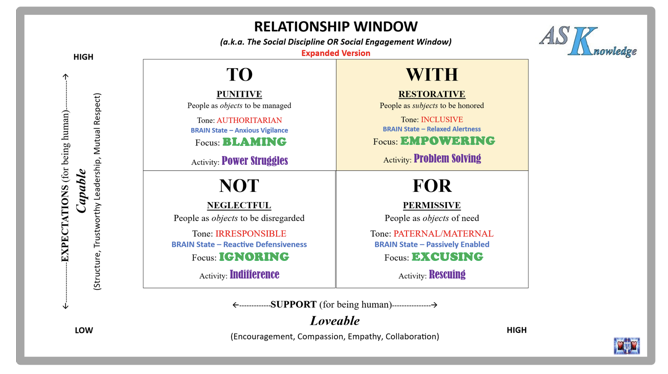
People (adults and children) are happier and more likely to make positive change when those in authority do things
WITH them rather than TO them or
FOR them… or NOT at all.
(See this diagram elsewhere on this site.)
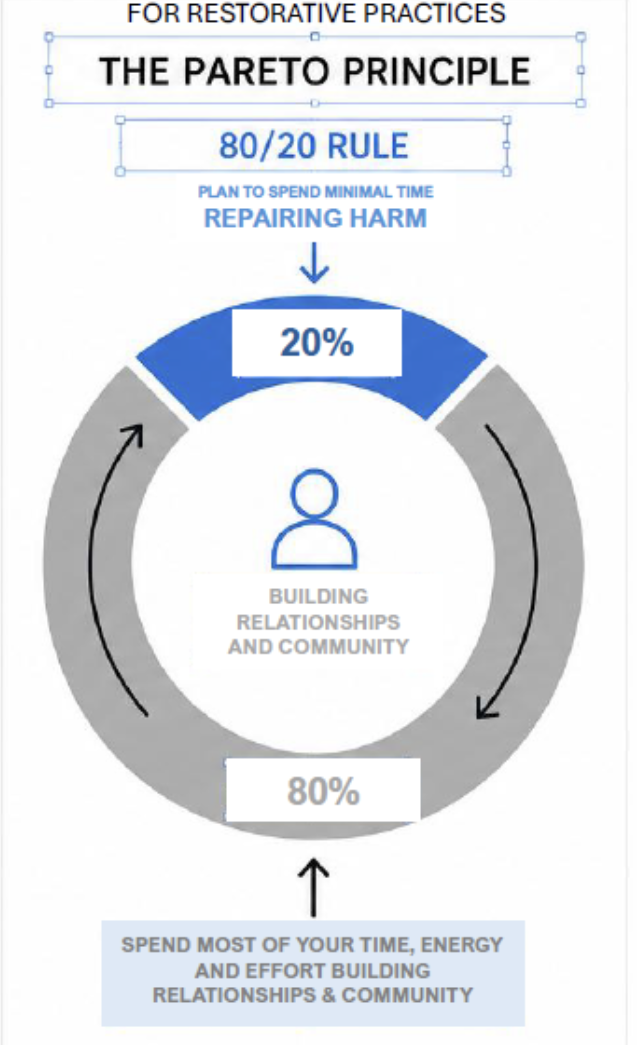
- which is commonly known as the 80/20 Rule - declares that roughly 80% of outcomes or consequences result from 20% of causes.
In Restorative Practices, we say that 80% of our work should be in the area of building and maintaining relationships, community and belonging. That leaves only 20% of our time being necessary to address issues that arise because we haven't done a good job of building relationships and community.
(See this diagram elsewhere on this site.)
The Social Engagement Window helps us recognize our focus is to do everything as much as possible WITH those that we serve, where people are SUBJECTS to be HONORED, with an Inclusive TONE, Relaxed Alertness is the preferred BRAIN STATE, and there is a Focus on EMPOWERMENT, and a primary Activity of PROBLEM SOLVING.
(See this diagram elsewhere on this site.)
Finally,
FAIR PROCESS IN LEADERSHIP
requires that those of us who lead in any way do so by first ENGAGING those for whom our decisions will have an effect, carefully EXPLAINING the rationale for why a decision must be made, and clarifying EXPECTATIONS for how we will move forward toward our particular outcomes. Then, it is just a matter of EXECUTING our plans, and EVALUATING the outcomes.
Ludo Van der Heyden, 2015
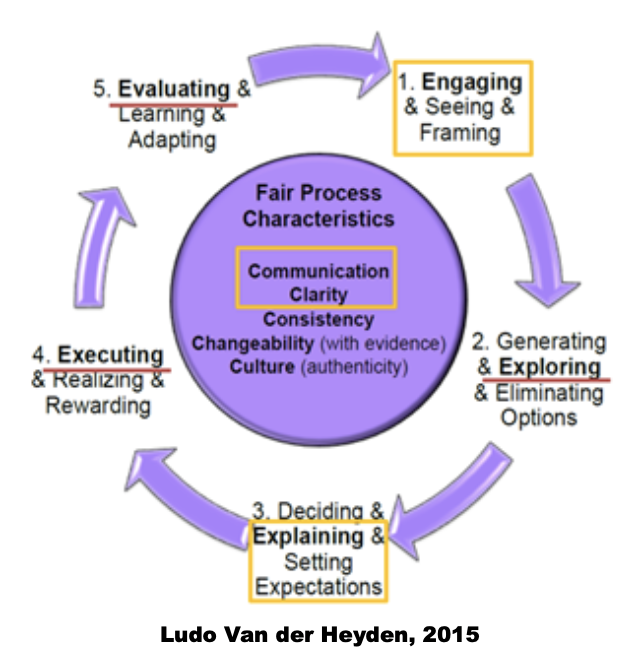
(See this diagram elsewhere on this site.)
This, then, is the essence of the restorative approach to practical and social engagement in a nutshell. All the rest are details. However, addressing these details with consistency and congruency is where restorative practices fidelity finds its fundamental and impenetrable foundation and most gratifying outcomes.
September 3, 2026
Wikipedia calls Milo Yiannopoulos “a British far right conspiratorial political commentator known for his opposition to Islam, feminism, and social justice.” Rightly so – since he is a former editor of Breitbart News. And that would be just for starters. If you know, you know.
We could easily slide down a rabbit hole of a hefty list of his questionable behaviors and rhetorical choices, but I invoke him here as a proverbial “poster child” for the power of epiphany. In particular, I mean the kind of awakening that can only come to those who keep themselves insulated from the experiences of others which do not mirror their own.
Long story blessedly short, Milo the Brit found himself ensnared in the very American deportation quagmire he is on record as declaring it would be very appropriate for “millions and millions” of other people to experience. Bottom line, his experience in the ICE dragnet finds him now admitting he had been very cavalier about other people’s trauma until the machinery terrified and humiliated him, and left him (in his words) “physically degraded” Oh, how different is the song he sings now!
But enough of his freshly current story. I only invoke it because it is perfectly indicative of the point I want to make about how easily most of us recommend for others that which we would never recommend for ourselves.
I often do an exercise with people of all ages where I ask, “How many of you have ever heard this before: ‘Treat others the way you want to be treated.’” When I ask, generally hands shoot right up. Then I ask, “How many of you think that's a really good way to live your life?” When I ask this question, hands shoot up, again. But then I ask, “So how many of you live your life that way every day? … and it's crickets.
What's interesting to note, here, is that there is no culture on the planet that's ever been studied that does not have some version of this message as part of their understanding. In many places, we call it the Golden Rule. And yet, despite the fact that almost all of us have heard the message, and think it's a good idea, somehow this does not motivate us to practice what we preach.
I cannot help but conclude that we will not make much progress in creating a world that works for all of us until and unless every one of us practices what we think and say is a good idea … treating others exactly the way we would want to be treated if the shoe were on the other foot.
But be aware, as we come to this conclusion, that there is a higher value. There is what many call the Platinum Rule, which invites us not only to treat people at least as well as we would treat ourselves, but invites us, instead, to treat them the way THEY want to be treated (though I would add the caveat “unless it causes problems for them or someone else.”)
However, we can't even CONSIDER the Platinum Rule because we're still so far removed from embracing the Golden Rule.
Those… like Yiannopoulos …who are quick to condemn others to punishments they would never choose to endure are part of the problem that we deal with in this country and the world. Somehow, we must find ourselves on a path that allows us to be more inclusive of people different from ourselves. We must understand, somehow and soon, that we are all in this together …neighbors and fellow humans… who are part of an unbroken fabric of life that cannot possibly prevail and continue unless the whole weaving can do so. What goes around, comes around
Don’t wait until what many call karmic debt must be paid by the boomerangs you have thrown out coming back to do damage to you, instead.
Milo did. But then he was treated like a common recalcitrant or combative criminal, and shackles were unceremoniously snapped onto HIS body …and that changed some things.
NOW … (Dare I say it?) … he’s “woke.”